
CONCORD, NH – U.S. Sen. Maggie Hassan was told during a Thursday Senate hearing by the acting director of ICE that the Department of Homeland Security “has worked with Governor Ayotte” on the economic impact of a proposed Merrimack ICE detention center.
Ayotte again immediately denied prior knowledge of the plan and posted the following statement on her official website: “This is simply not true. Director Lyons’ comments today are another example of the troubling pattern of issues with this process. Officials from the Department of Homeland Security continue to provide zero details of their plans for Merrimack, never mind providing any reports or surveys.”
Hours later, Ayotte released documents she says her office requested following Thursday’s hearing that detail how the Merrimack ICE facility is part of a national $38.3 billion “Detention Reengineering Initiative.” [See documents below.]
WATCH BELOW: Sen. Maggie Hassan questions Todd Lyons, acting director of ICE, during a Feb. 12 Senate hearing.
In an email accompanying the release of the documents, Ayotte said, “After my office inquired about the economic impact study following today’s Senate hearing, DHS has now for the first time distributed the document. Once the document was received, we immediately shared it with the Town of Merrimack. We are publishing this document on my website for the public to find.”
The documents show Merrimack is being targeted as part of a sweeping national $38.3 billion expansion of immigration detention facilities, and is part of a long-term national ICE detention network.
NH State Rep. Rosemarie Rung, D-Merrimack, reacted to the documents via a post on social media.
“Governor Ayotte shared the financial reports she received from ICE and, I kid you not, this is the most sloppy and third-rate work I’ve ever seen. The financials are pulled from the air with no basis and it appears the document was prepared for a facility in Oklahoma (they missed a ‘find and replace’),” wrote Rung.
“I’m going to ask the Governor to provide a financial analysis of the validity of these figures, aggressively oppose this proposal, and come to Merrimack to face the residents directly,” Rung wrote. “Also, I believe any plans for operation need to be predicated on a traffic study as I doubt Robert Milligan Parkway, which is a cul-de-sac can handle the estimated number of employees without additional egress, let alone where these employees plan to live.”
On Thursday the New Hampshire Bulletin reported on Hassan’s exchange with Lyons, during which Hassan referenced the change of plans for a similar ICE detention center in Mississippi. She noted the widespread opposition in New Hampshire to the Merrimack proposal.
“Will ICE similarly cancel the New Hampshire project based on these concerns and local opposition?” Hassan asked Lyons.
“No, ma’am,” Lyons replied. “Actually, DHS has worked with Gov. Ayotte — has spoke to the governor about economic impact.”
Lyons also said that DHS provided Ayotte with an economic impact summary, which Ayotte immediately denied – and which lead to the release just after 6 p.m. of the email and documents.
On Feb. 9 Ayotte called for the resignation of Sarah Stewart, Commissioner of the NH Department of Natural and Cultural Resources, who admitted that her department had provided information to ICE officials in mid-January but did not inform the governor.
What’s in the documents
The proposal is part of U.S. Immigration and Customs Enforcement’s “Detention Reengineering Initiative,” a $38.3 billion federal effort designed to expand detention capacity nationwide to 92,600 beds by the end of fiscal year 2026. ICE describes the initiative as a restructuring of its detention system to support increased arrests and removals, following the addition of 12,000 new enforcement officers.
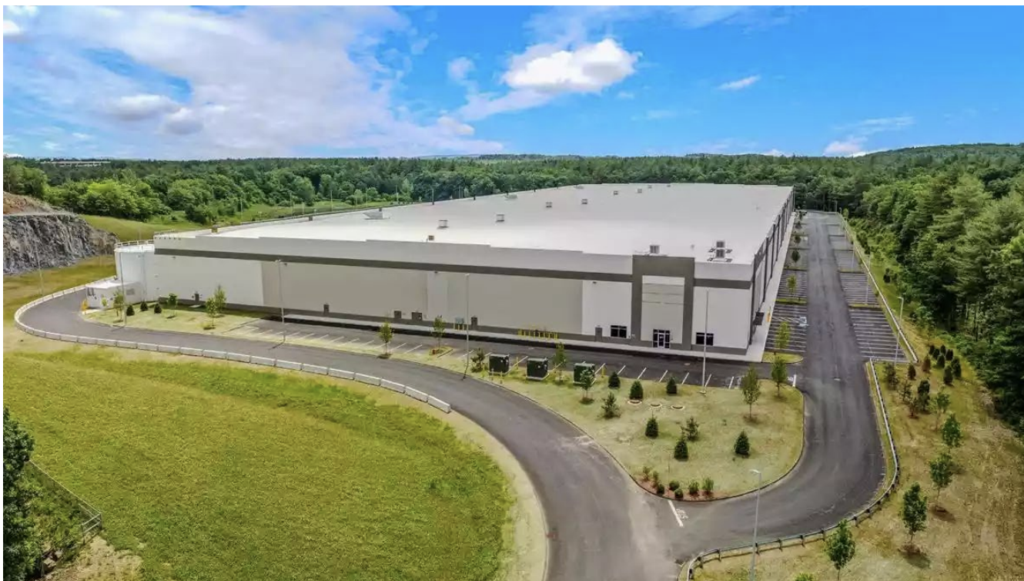
Among the properties identified is a 324,395-square-foot building at 50 Robert Milligan Parkway in Merrimack . ICE projects the site would house between 400 and 600 detainees and classifies it as a “processing site” within the agency’s new detention model.
According to ICE’s planning overview, processing centers are designed for short-term stays averaging three to seven days, serving as staging locations for transfers or removals. Larger facilities under the initiative are designed for average stays of up to 60 days. ICE states the new sites are intended to serve as long-term components of its detention system.
The documents outline that renovated facilities would include dormitories, intake and processing areas, courtroom space, medical and mental health services, visitation rooms, law libraries, recreation space, religious accommodations, and support services such as food, transportation, laundry, and IT operations.
ICE says it conducted engineering reviews of utilities and infrastructure before selecting each site. The agency evaluated water supply, wastewater systems, electrical capacity, and fire protection infrastructure, and determined that existing systems could support operations, with upgrades where necessary. The agency concluded the facility would have “no adverse effect on the community and surrounding properties.”
A separate Department of Homeland Security economic impact analysis estimates that retrofitting the Merrimack site would cost $158 million in 2026. That construction phase is projected to support 1,252 total jobs and generate $119 million in labor income and $31.2 million in total tax revenue.
Once operational, DHS estimates the facility would generate $46.6 million in direct annual spending, supporting 265 jobs each year and producing $36.6 million in annual labor income. The operations phase is projected to generate approximately $10.7 million annually in local, state, and federal tax revenues.
The economic modeling assumes the site would operate as a federal facility and therefore would not pay state or local property taxes.
If activated, the Merrimack facility would represent a permanent shift in the use of the site — not as a temporary overflow location, but as part of ICE’s long-term national detention infrastructure. What remains unclear is how local officials, emergency services, and residents will respond as more details emerge about the proposed conversion.
Proposed Merrimack ICE Facility
Location & Size
- 50 Robert Milligan Parkway, Merrimack
- 324,395 square feet
- Projected capacity: 400–600 detainees
Facility Type
- Classified as a “processing site”
- Designed for short-term stays averaging 3–7 days
- Part of ICE’s long-term national detention model
National Context
- Part of a $38.3 billion federal detention expansion
- Nationwide capacity target: 92,600 beds by FY2026
- Expansion follows addition of 12,000 new ICE officers
What the Facility Would Include
- Dormitories and intake areas
- Courtroom space
- Medical and mental health services
- Visitation and legal access areas
- Religious accommodations
- Recreation space
- Food service, transportation, and support operations
Utilities & Infrastructure
- Federal review of water, wastewater, power, and fire systems
- Agency states infrastructure can support operations, with upgrades if needed
- ICE asserts no adverse impact to surrounding community
Economic Impact (DHS Estimates)
Construction Phase (2026)
- $158 million retrofit investment
- 1,252 jobs supported during construction
- $31.2 million in tax revenue generated
Annual Operations
- $46.6 million in direct spending
- 265 jobs supported each year
- $10.7 million in annual tax revenue